
How to Choose the Right Video Production Companies in Abu Dhabi (A Practical Guide)


Anyone who has sat through a rushed pitch meeting with a production crew they barely know understands the feeling. The clock is ticking, the client is waiting for a proposal, and somebody on the team just typed video production companies in Abu Dhabi into Google for the third time this week, hoping the next search result explains things a little better than the last one.
This guide is written for that person. Not to sell a service, but to walk through what actually happens once you hire a video team in Abu Dhabi, what separates a good production from a forgettable one, and which questions tend to save people time, money, and a fair amount of stress.
Abu Dhabi's production scene has grown quickly over the past several years. Twofour54's media zone, the rise of independent studios, and a steady flow of corporate, hospitality, and government-independent projects have turned the emirate into a genuine production hub rather than a stopover on the way to Dubai. That growth is good news for brands, but it also means the market is more crowded, and picking the right partner takes a bit more thought than it used to.
What Video Production Companies in Abu Dhabi Actually Do
The phrase "video production company" covers a wide range of work, and that's part of what confuses first-time clients. Some studios specialize almost entirely in corporate content training videos, executive interviews, LinkedIn-style brand films. Others lean into commercial advertising, working with agencies to produce TV and social campaigns. Then there are studios built around live events, hybrid streaming, music videos, or documentary-style storytelling.
A full-service studio typically handles three stages of a project:
Pre-production is the planning phase. This is where scripts get written, storyboards get sketched, locations get scouted, and budgets get mapped against the creative brief. It's also where a lot of projects quietly fail, because rushing this stage almost always shows up in the final cut.
Production is the shoot itself — cameras, lighting, sound, direction, and the logistics of getting everyone and everything to the right place at the right time.
Post-production is where the raw footage becomes a finished piece: editing, color grading, sound design, motion graphics, and final delivery in whatever format the client needs, whether that's a 16:9 file for YouTube or a vertical cut for Instagram Reels.
Understanding this three-part structure matters because it changes how you evaluate a studio. A company with a beautiful reel of finished films might still be weak on production logistics, or vice versa. Ask to see examples from each stage, not just the polished final product.
Why the Search for "Video Production Companies in Abu Dhabi" Gets Complicated Fast
Here's something that surprises a lot of people: the hardest part of hiring a video team usually isn't finding companies. A quick search turns up dozens. The hard part is figuring out which ones are actually set up to handle your specific type of project.
A studio that excels at wedding films isn't necessarily the right fit for a corporate brand documentary. A team built for fast-turnaround social content may not have the crew or equipment for a multi-camera live event. This mismatch is the single biggest reason projects go sideways not bad crews, just the wrong crew for the job.
Who Actually Needs a Professional Video Production Team
It's easy to assume video production is only for big-budget commercials, but that's outdated thinking. In practice, the client list for a working studio in Abu Dhabi is far more varied.
Corporate brands use video for internal training, investor updates, and recruitment content. Hospitality groups — hotels, restaurants, beach clubs — rely on video to sell an experience that photos alone can't capture. Retail and e-commerce brands need product films that hold up across Instagram, TikTok, and paid ad placements.
Advertising agencies frequently outsource the actual filming and editing to a production partner while they manage the client relationship and creative direction. Startups use video to explain complex products in under sixty seconds. Musicians and artists need music videos and behind-the-scenes content that fits their release schedule. Event organizers need same-day highlight reels that go live before the event even ends.
What connects all of these is a simple truth: video is no longer a "nice to have" marketing extra. It's the format audiences actually engage with, and brands that ignore it are competing at a disadvantage.
Common Misconceptions About Hiring a Video Production Company
A few myths come up again and again in early conversations with clients, and clearing them up early tends to save everyone time later.
"Cheaper equipment means cheaper quality, full stop." Not exactly. Gear matters, but the person operating the camera and the person directing the shoot matter more. A skilled director with mid-range equipment will usually out-perform an inexperienced crew with the latest cinema camera.
"One crew can do everything." Some studios genuinely offer full-service production — audio, video, photography, live streaming, artist management — under one roof. Others specialize narrowly. Neither approach is wrong, but you need to know which one you're hiring before the contract is signed, not after.
"More footage automatically means a better edit." Overshooting without a clear plan often creates more problems than it solves. Editors end up drowning in hours of unusable footage, and deadlines slip. A tight shot list built around the actual story beats an unlimited amount of raw footage every time.
"The brief doesn't need to be detailed — the crew will figure it out on set." This is probably the most expensive misconception on the list. Professional crews can absolutely adapt on the day, but creative decisions made on the fly are far more likely to miss the mark than decisions made during proper pre-production.
How Professional Studios Approach a Project in Abu Dhabi
Watching an experienced production team work a project from brief to delivery reveals a pattern that's worth understanding, even if you're not the one holding the camera.
It usually starts with a discovery conversation — not a sales pitch, but a genuine attempt to understand the goal. Is this content meant to build brand awareness, drive direct sales, support a hiring campaign, or document a one-time event that will never happen again? The answer shapes almost every decision that follows.
From there, a treatment or creative concept gets built. This is essentially a short document or deck that outlines the visual direction, tone, pacing, and structure of the piece before a single frame is shot. Clients sometimes skip this step to save time, but it's usually the cheapest insurance policy in the entire process.
Location scouting comes next for anything shot outside a controlled studio environment. Abu Dhabi offers a genuinely wide range of backdrops — from the corniche and Saadiyat Island's cultural district to desert locations and the more industrial, modern architecture found around the city center. Each location comes with its own lighting conditions, crowd considerations, and logistical needs.
On shoot day, a well-run set runs on a schedule, with a clear chain of command between the director, director of photography, and production manager. Chaos on set almost always traces back to poor planning rather than bad luck.
Post-production is where the real storytelling happens. Editors shape pacing, colorists set the visual mood, and sound designers make sure dialogue is clear and music doesn't overpower the message. This stage often takes longer than clients expect, and rushing it is one of the most common ways a good shoot turns into a mediocre final video.
Planning Considerations Before You Reach Out to a Studio
A little preparation on the client side makes a measurable difference in how smoothly a project runs.
Start with the goal, not the format. "We need a video" is not a brief. "We need a ninety-second piece that explains our new loyalty program to existing customers" is a brief.
Think about distribution before production begins. A video built for a trade show screen behaves very differently from one built for a fifteen-second Instagram Story. Knowing where the content will live affects everything from aspect ratio to pacing to whether subtitles are essential.
Set a realistic timeline. Quality production takes time — for scripting, scouting, shooting, and editing. Compressing that timeline too aggressively usually shows up as a drop in quality somewhere along the line.
Gather reference material early. Even a folder of videos you admire, with notes on what specifically works about each one, gives a production team a much clearer starting point than a verbal description alone.
Production Considerations That Are Easy to Overlook
Certain details rarely make it into the initial conversation but end up mattering a great deal once the cameras roll.
Weather and lighting conditions in Abu Dhabi shift significantly across the year, and outdoor shoots need to be scheduled with that in mind. Midday sun creates harsh shadows that most cinematographers try to avoid, which is why early morning and late afternoon slots are so commonly requested for exterior filming.
Audio quality gets underestimated more than almost any other element. Viewers will tolerate imperfect visuals far more readily than they'll tolerate poor sound. A production team that treats audio as an afterthought is a warning sign worth noting.
Talent and on-camera presenters need proper briefing well before the shoot day.
Reading lines cold in front of a camera for the first time rarely produces a natural performance, no matter how confident the person is in a meeting room.
Backup planning matters more than people expect. Equipment fails, weather changes, and locations occasionally fall through. Studios with contingency plans — a backup location, a spare camera body, an alternate shoot date — tend to handle surprises without the client ever noticing there was a problem at all.
Quality Factors That Separate Strong Studios From Average Ones
A few signals tend to hold up consistently when judging the quality of a production company, regardless of budget size.
Look closely at how a studio's past work handles pacing and story structure, not just visual polish. Beautiful shots with no narrative flow rarely hold an audience's attention past the first few seconds.
Pay attention to audio mixing in sample videos. Clear, balanced sound with music that supports rather than competes with dialogue is a genuine skill, and it's one of the fastest ways to spot an experienced post-production team.
Ask about color consistency across a project. A commercial or brand film should feel visually unified from the opening shot to the closing frame, not like a patchwork of mismatched clips.
Notice how a studio communicates during the proposal stage. A team that asks thoughtful questions about your goals before jumping to logistics is usually the same team that will handle unexpected changes well once production begins.
Technology Trends Shaping Video Production in the UAE
The tools available to production teams have shifted noticeably in recent years, and it's worth understanding a few of the bigger trends, even as a non-technical client.
Drone cinematography has become far more accessible, giving even mid-sized productions access to sweeping aerial shots that once required helicopter rentals. Abu Dhabi's skyline and coastline lend themselves particularly well to this kind of footage.
Vertical and multi-format editing has become standard practice rather than an add-on request. Brands increasingly expect a single shoot to produce a horizontal version for YouTube, a square cut for feeds, and a vertical edit for Stories and Reels, all from the same footage.
AI-assisted tools have started showing up in post-production workflows — for tasks like rough transcript generation, initial color matching, or automated captioning — though the creative decisions still sit firmly with human editors and directors. Anyone promising a fully automated, hands-off production process is likely overselling what the technology can currently do well.
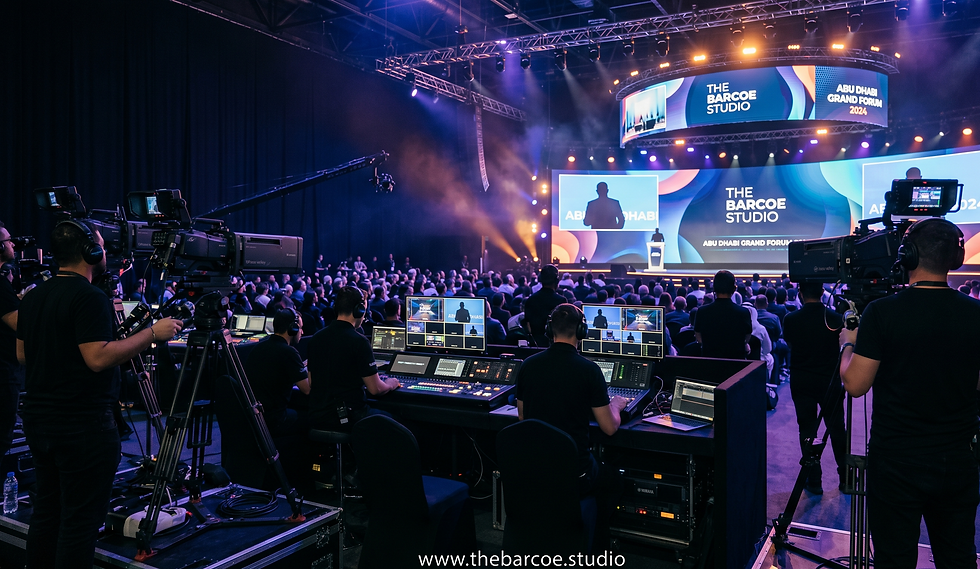
Live streaming and hybrid event production have grown substantially, driven partly by companies wanting to extend the reach of in-person events to remote audiences. This has pushed many studios to build stronger technical capabilities around multi-camera switching and real-time broadcast quality.
Industry Best Practices Worth Knowing
A handful of habits consistently separate smooth productions from stressful ones.
Written briefs beat verbal ones. Even a one-page document outlining goals, audience, tone, and key messages prevents a huge share of miscommunication down the line.
Site visits before shoot day reduce surprises. Whether it's checking power access, lighting conditions, or noise levels at a location, an in-person scout catches problems that photos alone tend to miss.
Clear ownership of final files and raw footage should be agreed upon before production starts, not after delivery. This is a simple conversation that avoids awkward follow-ups later.
Feedback rounds should be structured, not open-ended. Studios that build in a defined number of revision rounds tend to produce more focused, higher-quality final edits than those working off unlimited, informal feedback loops.
Frequently Overlooked Details That Affect the Final Result
A few smaller factors rarely make it into the initial brief but end up shaping the final product more than people expect.
Subtitle and caption quality matters enormously given how much video content gets watched with sound off, particularly on mobile feeds. Poorly timed or awkwardly translated captions can undercut an otherwise strong edit.
File delivery formats should be confirmed early. Different platforms have different technical requirements, and discovering a mismatch after delivery causes unnecessary delays.
Music licensing deserves a direct conversation. Using unlicensed tracks can create complications down the line, and a professional studio should be transparent about where music comes from and how it's cleared for use.
Archival and reuse rights are worth discussing upfront, especially for brands planning to repurpose footage across multiple campaigns over time.
Industry Outlook: Where Video Production in Abu Dhabi Is Heading
The demand for high-quality video content across the UAE continues to grow, driven by the sheer volume of brand storytelling now happening across social platforms, streaming services, and corporate channels. Abu Dhabi's continued investment in its creative and media sector — visible through the growth of Twofour54 and the broader push toward the city becoming a genuine content hub — means more studios, more specialized talent, and, eventually, more competitive pricing for clients as the market matures.
For brands, this means the bar for "good enough" video content keeps rising. Audiences are used to seeing polished work from global brands, and that expectation carries over to local content, regardless of budget. Studios that invest in genuine storytelling craft, not just equipment upgrades, are the ones likely to stay relevant as the market becomes more crowded.
How to Shortlist and Evaluate a Studio
When narrowing down a list of video production companies in Abu Dhabi, a structured approach works better than scrolling through Instagram portfolios alone.
Watch full videos, not just highlight reels. A thirty-second sizzle reel can hide pacing problems that only show up across a complete three-minute piece.
Ask for examples in your specific category. A studio with strong hospitality work may not have relevant experience producing a technical explainer video for a software company, and that's worth knowing before signing anything.
Request a clear breakdown of what's included at each stage pre-production planning, shoot days, editing rounds, and delivery formats so expectations are aligned from the start.
Pay attention to how quickly and clearly a studio responds during early conversations. Communication during the sales process is usually a fair preview of communication during the actual project.
For companies working across the wider UAE, it's also worth checking whether a studio has genuine, established experience in both Abu Dhabi and Dubai, since production logistics, locations, and crew availability can differ between the two cities. Teams like The Barcoe Studio, based in Abu Dhabi's Twofour54 media zone, work across both emirates and combine video production with photography, audio production, and event and artist management under one roof, which can simplify coordination for brands running multi-format campaigns.
Final Thoughts
Choosing between video production companies in Abu Dhabi isn't really about finding the "best" studio in some general sense — it's about finding the studio whose strengths line up with your specific project. A team built for fast social content, a team built for cinematic brand films, and a team built for live event coverage are three different skill sets, even if they all advertise "video production" on their homepage.
The clients who end up happiest with the final result are usually the ones who invested a bit of time upfront: writing a real brief, watching full sample videos instead of highlight reels, and asking direct questions about process rather than just pricing. That groundwork pays off in a smoother production and, more importantly, a finished video that actually does what it was made to do.
Frequently Asked Questions
What do video production companies in Abu Dhabi typically offer?
Most studios offer pre-production planning, filming, and post-production editing, though the range varies. Some focus on corporate and commercial content, others on events, music videos, or live streaming. Full-service studios often combine video with photography and audio production, which can simplify coordination for brands running multi-channel campaigns.
How long does a typical video production project take?
Timelines vary widely depending on complexity. A simple social media clip might take a few days from brief to delivery, while a full brand film with multiple locations and extensive post-production can take several weeks. Rushing pre-production to hit a tight deadline usually affects the final quality.
What should I include in a video production brief?
A strong brief covers the goal of the video, the target audience, where it will be shown, the tone you're aiming for, and any reference videos you admire. The more specific the brief, the fewer surprises come up during production and editing.
Do video production companies in Abu Dhabi also handle photography?
Many do, particularly full-service studios that combine video, photography, and audio under one team. This can be useful for brands that need consistent visual style across both moving and still content from the same shoot day.
How do I know if a studio's portfolio is a good fit for my project?
Look for full sample videos in your specific category rather than short highlight reels. A studio strong in hospitality or event coverage may not have the right experience for a technical explainer video, so category-specific examples matter more than overall production value.
What's the difference between corporate video and commercial video production?
Corporate video typically covers internal communications, training, recruitment, and executive content, aimed at employees or stakeholders. Commercial video is built for external marketing and advertising, aimed at customers, and usually involves more creative direction and a stronger emphasis on brand storytelling.
Is drone footage commonly used in Abu Dhabi video production?
Yes, drone cinematography has become increasingly common for capturing Abu Dhabi's skyline, coastline, and desert landscapes. It's frequently used in hospitality, real estate, and brand films where a wide establishing shot adds production value.
How many rounds of revisions should I expect during editing?
This varies by studio and project scope, but most professional productions build in a defined, agreed number of revision rounds rather than leaving feedback open-ended. Structured feedback tends to produce a tighter, more focused final edit.
What makes audio quality so important in video production?
Audiences are far more forgiving of imperfect visuals than poor sound. Background noise, unclear dialogue, or unbalanced music levels can undermine an otherwise well-shot video, which is why experienced studios treat audio as a core part of the production, not an afterthought.
Can one production company handle both Abu Dhabi and Dubai shoots?
Some studios work across both emirates, which can be useful for brands running campaigns in multiple cities, since it keeps creative direction and post-production style consistent. It's worth confirming that a studio has genuine, established experience in both locations rather than treating one as an occasional add-on.
What's the best way to prepare on-camera talent before a shoot?
Sharing the script or key talking points well in advance, holding a short rehearsal, and briefing presenters on tone and pacing all help produce a more natural on-camera performance. Reading lines cold on shoot day rarely looks as polished as a briefed, rehearsed delivery.
Do I need a different video format for social media versus a website?
Usually, yes. Social platforms often favor vertical or square formats optimized for mobile viewing, while websites typically use horizontal formats. Many studios now shoot with multiple formats in mind from the start, so one shoot day can produce several optimized versions.


Comments