
Media Production in Abu Dhabi for Brands and Artists Who Mean It

Abu Dhabi's creative output has changed shape. Brands that once commissioned a corporate video every few years are now running continuous content operations. Artists are releasing visuals that compete on a global platform. Events are broadcast live to audiences who expect broadcast quality. The appetite for video is enormous — but appetite alone doesn't produce work that holds attention, builds credibility, or survives a discerning audience's scroll. Most media production in Abu Dhabi sits somewhere between adequate and forgettable. What separates the work that actually performs is the rigour of the process behind it — and that is not something every production company is set up to deliver.
What Media Production in Abu Dhabi Actually Involves
The term gets used loosely. Someone with a capable camera and a decent edit suite can call themselves a media production company, and in a market growing as fast as Abu Dhabi's, plenty do. But media production — the kind that serves a brand campaign, a music video release, a live broadcast, or a serialised content strategy — is a discipline with a structure. It begins with questions before it begins with equipment.
At its core, production is about translating intent into a visual and sonic experience that communicates something specific to a specific audience. That requires pre-production: research, scripting, creative direction, crew coordination, and detailed planning that converts a vague brief into a precise shoot plan. It requires the right people in the right roles on the day — a director who can hold a creative vision under pressure, a cinematographer who understands how light shapes story, a sound recordist who treats audio as a primary creative concern rather than an afterthought. And it requires a post-production process that shapes raw material into a finished piece with genuine narrative coherence.
The UAE context matters here. Abu Dhabi's business and creative community — hospitality groups, real estate developers, entertainment brands, fashion labels, cultural institutions — is producing content at a volume and standard that was genuinely unimaginable five years ago. The audiences consuming that content have absorbed years of high-quality global media. Their visual literacy is real, and it means they register the difference between production that was considered and production that was rushed, even if they cannot articulate precisely why. Trust is built or lost in that register.
The Range of Work That Defines Media Production at This Level
Corporate video has evolved considerably in the UAE. What was once a functional category — talking heads, organisational announcements, presentations filmed in a boardroom — has become a genuine storytelling discipline. Executive interview series, brand culture films that speak to talent and investors simultaneously, internal communications designed to build cohesion across multinational teams: these require the same narrative craft as any other production. The corporate video work coming out of Abu Dhabi's business community increasingly reflects this shift, and the production companies that haven't kept pace with it are visible in the quality of their output.
Brand and commercial video operates under a different kind of pressure. A campaign film for a product launch or a promotional video for a regional brand reaches an audience that makes an immediate judgement. The UAE market is one where audiences are exposed to international creative standards daily — through global streaming platforms, international advertising, and a media environment without a domestic ceiling. That exposure means production quality is not a differentiator; it's a baseline. A brand film that reads as underproduced doesn't just underperform — it actively undermines the brand identity it was made to support.
Music video production is where the technical and the deeply personal intersect. An artist's visual output isn't decoration for the music — it's an extension of their identity, their creative positioning, and the world they're asking an audience to enter. That demands a production approach grounded in the artist's own creative language rather than a generic visual template. Concept development for music videos is a collaborative process that starts with understanding the artist's sound, their audience, and the emotional register they want to occupy. Getting that wrong produces something that looks like a music video but communicates nothing.
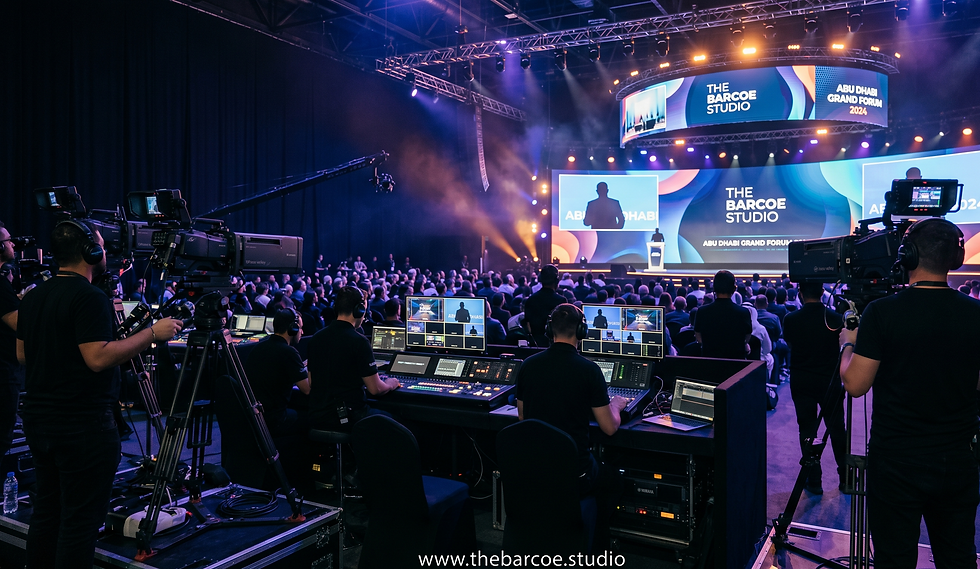
Event video and live streaming present a production challenge of an entirely different kind. A conference, award ceremony, brand activation, or product launch happens once, in real time, with no opportunity to reset. Multi-camera setups, live direction, simultaneous broadcast across platforms, and the pressure of capturing unrepeatable moments all run concurrently. The technical complexity is significant. The margin for error is none.
Social media video production has matured from an afterthought into a primary content category for brands operating across Instagram, TikTok, and YouTube. Platform-native content doesn't simply mean shorter — it means a fundamentally different approach to pacing, framing, hook structure, and audience psychology. Abu Dhabi brands building consistent content pipelines understand this distinction. The ones producing scaled-down versions of broadcast content for social channels wonder why their numbers don't move.
Documentary and editorial video rounds out the range — long-form brand storytelling, artist documentaries, and behind-the-scenes narrative films that build an audience relationship over time rather than delivering a single impression. This format is growing in demand precisely because it does something shorter content cannot: it creates depth. Audiences who watch a thirty-minute brand documentary come away with a relationship, not just a memory.
The Production Process — From Concept to Final Delivery
Every project at a serious production level follows a structure that begins long before a camera is switched on and continues long after the shoot day ends. Pre-production is where the outcome is decided, even if it isn't yet visible.
The process begins with a discovery conversation — not a brief review, but a genuine inquiry into what the project needs to achieve. Who is the audience? Where will the content live? What should a viewer feel, think, or do after watching it? What does the brand or artist already have in terms of visual identity, and what needs to be built? These questions shape everything: the creative concept, the tone, the locations or studio configuration, the casting decisions, and the shot plan that will guide the crew on the day. A mood board that everyone has genuinely agreed on is worth more than hours of reshooting because the creative direction wasn't established before production started.
Scriptwriting and storyboarding translate concept into a frame-by-frame plan. This isn't bureaucracy — it's the mechanism by which a creative idea becomes executable. A director who arrives on set with a storyboard has already solved most of the creative problems before they become production problems.
Production is where discipline meets the unpredictable. A prepared crew — one that has rehearsed the shot list, understood the lighting conditions, and pre-built the setup — creates the conditions in which something genuinely spontaneous and alive can be captured. The paradox of great production is that the more thoroughly it is planned, the more freedom exists within it. Directors who know what they're looking for can recognise when something better appears unexpectedly and take it. Crews who are operating reactively cannot afford that kind of attention.
Post-production is where the story is finally told. Editing isn't the mechanical assembly of clips in sequence — it's the craft of pace, rhythm, and emotional logic. The moment a cut happens, why it happens, and what the eye sees immediately before and after: these decisions determine whether a finished piece holds a viewer's attention or loses it. Colour grading gives the footage its emotional temperature — a grade that contradicts the intended mood will undermine writing, performance, and composition in the same frame. Sound design and audio mixing are equally decisive; audiences forgive imperfect visuals far more readily than they forgive audio that breaks the experience.
Final delivery accounts for the full range of outputs: broadcast-mastered files, web-compressed versions, platform-specific social formats, and outdoor or large-screen specifications if needed. The discipline that governs pre-production through post-production does not change with the scale of a project. Only the execution changes.
Why Abu Dhabi Has Become a Media Production Destination
Abu Dhabi has always carried weight as a regional capital. What has shifted is the nature of that weight. The creative and media industries here are no longer emerging — they are operating, producing work that circulates regionally and internationally, and attracting artists, brands, and production talent who recognise that the city can support serious work at a serious level.
Part of the appeal is environmental. Abu Dhabi offers a visual range that few cities can match: a modern skyline that holds its own against any international reference, desert landscapes that shift in colour and texture with the light, cultural architecture that carries genuine narrative weight, and a coastal environment that provides a different mood again. Production teams based here don't need to travel to access visual variety — it exists within the emirate, often within an hour's drive.
Mohammed Bin Zayed City, where The Barcoe Studio operates, has developed as a practical base for creative and production work — accessible, well-connected, and removed from the congestion of more central areas without being distant from the city's key venues and locations. For productions that combine studio-based work with on-location shoots, the position is genuinely useful.
The commercial argument for video production in Abu Dhabi has also solidified. Digital advertising spend across the UAE has grown consistently, and video has absorbed a disproportionate share of that growth. For brands that once treated video as an occasional campaign tool, it has become a permanent line in the marketing operation.
That shift has professionalised the expectations placed on production companies — clients are more sophisticated, briefs are more specific, and the tolerance for production that doesn't meet an agreed standard has dropped considerably.
International brands and touring artists working across the Gulf increasingly seek local production partners who understand how content lands in this region. Cultural nuance, platform behaviour, audience expectations, and the specific visual language that resonates with Gulf audiences are things that cannot be researched from outside the market. They are understood from inside it.
What to Look for When Choosing a Media Production Company in Abu Dhabi
The difference between a production company and a production partner is felt most clearly when a project runs into complexity. A company that provides crew and equipment hands a brief back to the client whenever a creative decision needs to be made. A partner brings a point of view, contributes to the concept, and takes genuine ownership of the outcome.
Creative direction is the quality that determines which side of that line a company sits on. It's evidenced not in what a company says about itself, but in the consistency and intentionality of its portfolio — whether the work shows a distinct visual sensibility or simply demonstrates technical competence across a range of different briefs. A portfolio that reveals strong storytelling instincts, clear compositional thinking, and an ability to sustain a creative identity across different project types tells you something meaningful about what working with that company will produce.
End-to-end capability matters for projects of any real scale. Coordinating separately between a scriptwriter, a production crew, and a post-production editor introduces inconsistency at every handover point. A company that manages concept through to final delivery maintains creative continuity and removes a significant coordination burden from the client. The review process during post-production is where this is most acutely felt — a transparent, iterative approval process with clear communication at each stage is not a bonus feature of professional production. It is part of the service.
Market understanding is a consideration that gets underweighted. The UAE has specific platform behaviours, cultural touchpoints, and audience sensibilities that shape how content performs. A production company familiar with the Abu Dhabi and wider UAE market — one that understands what resonates with regional audiences, what the distribution landscape looks like, and how content needs to be formatted for different Gulf platforms — will produce work that is built to perform in this market, not imported from a different one.
FAQs
What is media production and how does it differ from basic video filming?
Media production is a structured creative process that encompasses pre-production planning, professional crew direction, and disciplined post-production — not simply recording footage. Basic video filming captures what is in front of a lens. Media production constructs what appears in front of it: the concept, the light, the performance, the narrative structure, and the final edit that shapes how an audience experiences the piece. The distinction is the difference between documentation and communication, and it determines whether a finished video functions as intended or simply exists.
What types of video content does a media production company in Abu Dhabi typically produce?
A full-service media production company in Abu Dhabi produces across a wide range of formats — corporate films, brand campaign videos, music videos, event coverage and live streaming, social media content for platforms including Instagram and TikTok, documentary-style brand storytelling, and editorial content for artists and public figures. The specific mix varies by company, but a production partner with genuine breadth can adapt its process and creative approach to serve both commercial briefs and creative projects without treating them as categorically different kinds of work.
How long does a professional media production project take from start to finish?
Timeline depends on the nature and complexity of the project rather than any fixed formula. Pre-production — which includes concept development, scriptwriting, storyboarding, location scouting, and crew coordination — takes longer for complex productions with multiple locations, cast, or custom set builds. Post-production duration is shaped by edit length, the number of revision rounds, and whether colour grading, sound design, and motion graphics are involved. A realistic timeline is established during the pre-production conversation and reflects the specific requirements of the brief, not an assumed standard.
What makes music video production different from other types of video production?
Music video production starts from a fundamentally different place: the creative brief is the music itself. Every visual decision — colour palette, location, performance style, edit rhythm, narrative concept — must serve and extend the emotional and artistic identity of the track and the artist. This demands a production team with strong conceptual instincts and genuine familiarity with visual storytelling as a creative form, not just a technical process. Unlike corporate or commercial video, where the message is usually explicit, music video asks the viewer to feel something before they understand it.
How do Abu Dhabi brands use video production to build their presence across digital platforms?
Brands in Abu Dhabi are increasingly approaching video as an ongoing content function rather than a periodic production. This means building content pipelines that feed different platforms with formats suited to each — short-form video for social channels, longer brand films for websites and YouTube, event footage for credibility and reach, and documentary content for audience depth. The brands building the strongest digital presence are those treating video production with the same strategic consistency they apply to any other brand communications channel, rather than commissioning individual pieces in isolation.
What should I prepare before approaching a media production company in Abu Dhabi?
The most useful preparation is clarity on purpose rather than a fully formed creative brief. Understanding who the content is for, where it will be distributed, and what a viewer should think or feel after watching it gives a production team the context they need to contribute meaningfully from the first conversation. References — whether existing content you admire, a visual mood, or a tone you want to capture — are helpful but not required. The production partner's job is to develop the creative direction from the conversation; the client's job is to know what the content needs to achieve.
The decision to commission video production is, at one level, a creative one. At another level, it is entirely strategic — a choice about how a brand or artist shows up, what impression they make, and whether the investment in production actually converts into the audience response it was designed to produce. The Barcoe Studio sits at the intersection of those two considerations: a production company with its roots in music and live performance, its experience built across brand, artist, and commercial work, and its operations based in Abu Dhabi with reach across the UAE. The portfolio is available to review. If a project is forming — even at the brief stage — a conversation about it is a worthwhile starting point.
The right production partner doesn't just make your content look better. They make it work harder.


Comments