
When the Show Looks Effortless, Someone Backstage Is Working Very Hard

A guest sees a host walk onto the stage exactly as the music fades and the lights shift to a warmer tone. It looks like one smooth moment.
Backstage, several people may have just confirmed that exact cue over headsets in the seconds before it happened: the audio operator dropping the track, the lighting operator triggering the next scene, the stage manager giving the host a hand signal, and the show caller counting down so nobody moves too early or too late.
That is the gap most people never need to think about.
What feels like one continuous experience to the audience is actually a long sequence of timed handoffs between the people running the show.
Guests See an Event. Crews See a Sequence.
From a seat in the audience, a live event unfolds as one story.
The room fills. The lights dim. Someone walks onto the stage. A presentation begins. There is a break. Another segment follows. Eventually, the event ends.
There is no reason for the audience to think about how those moments connect. In fact, good production is designed so they do not have to.
Behind the scenes, however, those moments are not experienced as one continuous event.
They are a sequence.
Every segment has a start point, an end point and a set of conditions that need to be true before the next one can begin.
The presenter cannot walk on until the microphone is ready.
The video playback may need to wait until the previous speaker has cleared the stage.
The lighting cue may need to land immediately after an audio change.
The presentation operator needs to know which slide deck is live.
The stage manager needs to know whether the next speaker is actually standing where they are supposed to be.
This is true whether the event is a corporate product launch in Dubai, a concert in Abu Dhabi or a hybrid conference reaching viewers outside the room.
The audience experiences one event.
The crew experiences dozens of dependencies.
The Run-of-Show Is the Shared Map
Ask different people on a production team to describe the event and they will naturally focus on different things.
The audio team thinks about microphones, playback and levels.
The lighting team thinks about scenes and cues.
Stage management is thinking about speakers, performers and movement.
The video team may be managing presentation feeds, playback and screens.
What keeps all of those responsibilities aligned is the run-of-show.
It is the shared schedule that explains what happens, when it happens and who is responsible for each transition.
It is less a creative document than an operational map.
The lighting operator does not necessarily need to understand every detail of a presentation. They need to know when the next lighting state should happen.
The stage manager may not need to know every line of a speech. They need to know when the speaker is due to finish and who needs to be ready next.
The run-of-show works best when everyone is working from the same version.
That sounds obvious until somebody receives a revised schedule ten minutes before doors open while someone else is still looking at the previous one.
Live events move quickly enough that version control can become a production issue of its own.
Individual Segments Are Usually Easier Than the Gaps Between Them
A single speaker giving one presentation is relatively straightforward to understand.
There is a microphone.
There may be a presentation.
There is a lighting state.
The speaker walks on, presents and walks off.
The difficulty often sits between that presentation and whatever happens next.
Perhaps the next speaker is still backstage reviewing their notes while their cue approaches.
The lighting team is ready for the next scene, but the presentation operator is still waiting for an updated file.
The stage crew needs to remove furniture before a performance can begin.
The audio engineer needs to switch from presentation microphones to an artist's input setup.
Every department may be completely prepared for its own task.
The risk lies in the handoff between those tasks.
This is where much of live event production becomes less about isolated technical skills and more about sequencing.
A smooth transition requires several people to finish different jobs at nearly the same moment.
One Delay Rarely Stays in One Place
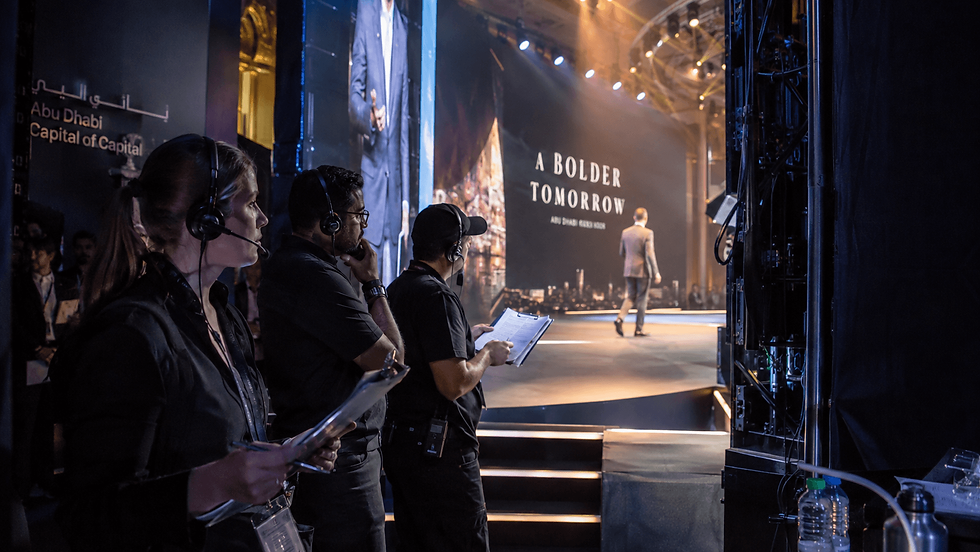
Live events operate as connected systems.
If a speaker runs six minutes longer than scheduled, those six minutes do not simply disappear.
They may reduce the time available for the next stage reset.
A technical check scheduled during a break might suddenly have less time.
An artist waiting backstage may need a revised call time.
A video playback that was supposed to happen after a specific transition may now need to be moved.
The schedule starts compressing.
This is why experienced production planning pays so much attention to dependencies.
The question is not only:
How long does this segment take?
It is also:
What needs to happen immediately before and after it?
Stage resets are a good example.
A reset that happens while guests are taking a break can be relatively forgiving.
A reset that needs to happen while the audience is still watching has to be considerably more controlled.
Crew movement, cables, furniture, microphones and equipment changes all need to happen quickly enough that the transition still feels intentional.
Someone Has to Own the Decision, Not Just the Task
When something changes during a live show, the problem is not always technical.
Sometimes the real issue is uncertainty over who has authority to make the next decision.
A microphone handoff may be missed because two people each thought the other person was handling it.
A cue that worked perfectly during rehearsal may not fit anymore because the sequence around it has changed.
A presenter may ask for an extra minute just as the stage manager is preparing the next walk-on.
Several technically competent people can make a situation worse if they all issue different instructions at the same time.
That is why live productions usually benefit from a clear decision path.
Depending on the event, a show caller, stage manager or production lead may be responsible for coordinating the timing of the next move.
The value is not hierarchy for its own sake.
It is speed and clarity.
One timely instruction is more useful than several conflicting ones arriving simultaneously.
Events in Dubai and Abu Dhabi can add additional layers: international speakers, multilingual segments, artists arriving on different schedules, hybrid components, multiple suppliers and stakeholders requesting last-minute adjustments.
Those conditions make clear ownership of transitions even more important.
Teams involved in event planning and technical production in the UAE, including Abu Dhabi-based BarCoe Studio, work in an environment where staging, artists, technical departments and timing need to connect rather than operate as separate pieces.
The individual elements matter, but the handoffs between them are what turn those elements into one event.
What Technical Rehearsal Is Really Testing
Technical rehearsal is often described as the time when the crew confirms that everything works.
The microphone works.
The video plays.
The lighting scene looks correct.
Those checks matter, but testing each element independently is only part of the job.
The more important question is whether those elements work together in sequence.
Does the lighting change at the right point after the audio cue?
Does the presenter receive the walk-on signal with enough time to reach the stage naturally?
Does the correct presentation appear on screen when the speaker begins?
If a playback file was updated after the first rehearsal, does the operator now have the latest version?
Does the stage reset actually fit into the time allocated to it?
A rehearsal should expose the points where one department depends on another.
That is where real-event problems are most likely to appear.
Running the sequence end to end also allows the team to see whether the written schedule reflects how long things actually take.
A transition that looks like thirty seconds on paper may need ninety seconds once real people and equipment are involved.
It is much better to discover that during rehearsal than during the live show.
Backstage Communication Has to Be Short and Clear
During a live event, there is rarely time for lengthy discussion.
A cue needs to be understood immediately.
That is why backstage communication tends to become concise.
Stand by.
Go.
Hold.
Clear.
Two minutes.
Speaker ready.
Video ready.
Audio ready.
The exact language can vary between teams, but the principle is the same: communication needs to be unambiguous.
This becomes especially important when several departments are listening to the same communication channel.
A long explanation about why a cue has changed may be useful before the show.
During the show, the crew often needs only the updated instruction.
That clarity helps prevent one small change from creating confusion across several departments.
Good Production Disappears
The unusual goal of good live-event coordination is to become almost invisible.
When a transition works perfectly, the audience rarely thinks about it.
The music fades.
The lights change.
The presenter walks on.
The microphone works.
The presentation appears.
Everything simply feels like it happened at the right time.
That apparent simplicity is usually the result of preparation, rehearsal, communication and people making many small decisions behind the scenes.
The audience does not need to see the run-of-show.
They do not need to hear the headset calls.
They do not need to know that one segment ran long and the crew quietly recovered the schedule during the next transition.
They only experience whether the event feels controlled.
That is the paradox of live event production.
The more successfully the complexity is managed backstage, the less complicated the event feels from the audience.
Comments